Harold Carnes
American PsychoHarold Carnes is a well-connected Wall Street man whose most important function is not to investigate Patrick Bateman successfully but to absorb Bateman's confession without recognizing it as confession. His composure, professional fluency, and reflexive assumption that shocking statements are jokes embody the social world that allows Bateman's violence to pass through ordinary conversation. When Carnes finally says that he had dinner with Paul Owen twice in London only ten days earlier, he turns Bateman's declaration into an encounter with an apparently impossible reality and becomes the chief human instrument of the novel's uncertainty about what has happened.
Identity and Social Position
Harold Carnes appears within the same elite professional and social circuit as Patrick Bateman, a world organized by expensive clothing, restaurants, clubs, business connections, and effortless recognition. At the World's End party on the Upper East Side, Carnes is described in a wool suit by Gieves & Hawkes, a silk twill tie, a cotton shirt, and shoes by Paul Stuart. He stands at the bar drinking champagne and discussing the prospect that Japan will own most of the United States by the end of the 1990s. His appearance and conversation place him firmly inside the culture of polished surfaces and market-oriented expertise that surrounds Bateman.
Carnes is also presented as someone whose social authority depends on the appearance of possessing useful information. Patrick is relieved when Carnes continues dispensing what seems to be valuable and novel commentary, even while noticing a faint English accent. That relief is revealing: Carnes need not offer moral insight or personal intimacy to command attention. His status is secured by manner, clothing, topical knowledge, and the easy circulation of opinions at a party. In this environment, credibility is performed through style as much as established through evidence.
Connection to the Owen Investigation
Carnes is linked to the inquiry into Paul Owen's disappearance through his contact with Patrick's office. Donald Kimball identifies himself as a private investigator hired by Meredith Powell to investigate Owen's disappearance, and the investigation has already reached the crucial fact that Owen's datebook, verified by his secretary, placed him at dinner with Marcus Halberstam. Kimball tells Patrick that he has questioned Halberstam, making the apparent identity of the dinner companion part of the case's documentary trail.
The investigation also establishes a competing account of Owen's whereabouts. Owen's answering machine contains a message saying that he went to London, although his girlfriend does not believe that explanation. Against this unresolved evidence, Patrick's own narrative places him with Owen at Texarkana under the name Marcus Halberstam, followed by the transport of Owen's body to an abandoned unit in Hell's Kitchen, where Patrick puts the body in an oversized porcelain tub and covers it with lime. Carnes becomes important because his later statement appears to validate the London story rather than Patrick's account: he claims to have had dinner with Owen twice in London only ten days earlier.
The Confession and Its Rejection
After killing Owen, Patrick tries to convert private dementia into public fact. He screens calls, avoids contact, and later leaves a message for Carnes admitting everything, including dozens of murders. The confession is not treated as a solemn legal statement; it is delivered to an answering machine while Patrick is surrounded by the aftermath of a night of violence, police activity, and his own emotional collapse. He tells the machine that he left a woman in a parking lot near a Dunkin' Donuts, calls himself a sick man, then calls back and leaves another message warning Carnes to keep his eyes open if Patrick appears at Da Umberto's.
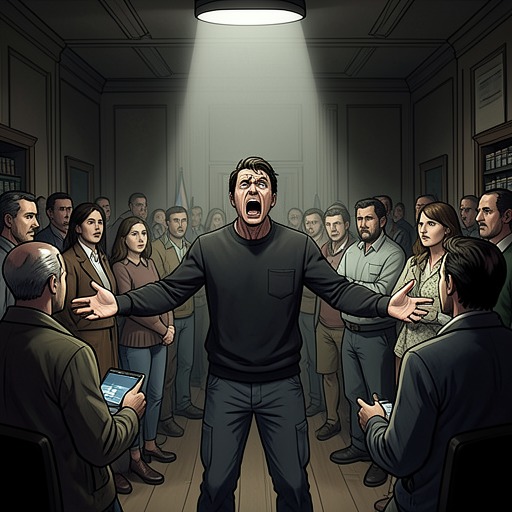
At the World's End party, Patrick confronts Carnes about the message while drunk and anxious. He first asks whether Carnes received it. Carnes seems confused, then laughs and calls it hilarious, assuming that Patrick's account was a joke. Patrick confirms that he made the message, but Carnes's response shows that the social setting has already neutralized its meaning. The confession has entered the category of witty exaggeration, the same conversational space as financial predictions, fashion talk, and club gossip.
Patrick then abandons implication and states the matter directly. He tells Carnes that he killed Paul Owen, chopped off Owen's head, tortured dozens of girls, and meant the entire message. When Carnes still tries to leave, Patrick insists that he killed Owen and liked it, stressing each part of the claim in the hope that repetition will force recognition. Instead, Carnes answers that the claim cannot be true because he had dinner with Paul Owen twice in London only ten days earlier. His response does not investigate Patrick, accuse him, or summon help. It simply replaces Patrick's testimony with another socially confident assertion.
Narrative Function and Unreliability
Carnes is central to the novel's unreliable-narration structure because he supplies an external contradiction without resolving it. Patrick's narration gives a detailed account of Owen's murder, concealment, and the attempt to erase the body. The investigation gives a separate chain of records and interviews. Carnes's statement then appears to make Patrick's account impossible, yet the text does not provide an independent way to decide whether Carnes is mistaken, whether identities have been confused, or whether Patrick's murders are occurring in a distorted psychological reality.
The contradiction is intensified by the social indistinguishability of the men around Patrick. Names, faces, professional positions, and dates repeatedly seem interchangeable, and Carnes's response depends on that world of mutual misrecognition. Patrick approaches him as the person who can confirm the truth of a message, but Carnes receives him as someone else or treats the whole exchange as comic performance. The scene therefore makes identity itself unstable: a confession can be heard, understood as a joke, and discarded without any visible institutional consequence.
Carnes's earlier role in Patrick's thinking also helps explain the pressure placed on the encounter. Patrick has already imagined calling Carnes to disclose his private dementia, and when he finally does so, the confession is framed as an attempt to make what has remained internal become public. Carnes's failure to accept it leaves Patrick without the recognition he seeks. The expected movement from secret crime to acknowledgment never occurs; the confession becomes another failed performance before an audience trained not to believe anything that disrupts the surface.
Characterization and Significance
Carnes is characterized less through introspection than through social reflexes: he drinks champagne, discusses national economic power, laughs at an extreme message, and tries to leave when Patrick becomes explicit. Those actions make him neither a conventional detective nor a moral counterweight. His polished normality is precisely what gives the final exchange its force. He does not need to be malicious to become part of the machinery that protects Bateman's world from knowledge; ordinary disbelief, courtesy, distraction, and the assumption of irony are sufficient.
His encounter with Patrick also exposes the gap between confession and consequence. Patrick presents murder as the truth of his existence, but Carnes's response converts truth into entertainment and then into an impossibility supported by an apparently verifiable dinner in London. The scene leaves Carnes as an emblem of a society in which people are legible through clothes, names, reservations, and professional affiliations, yet remain morally unreadable. His final contradiction does not merely challenge Patrick's story. It demonstrates how completely the surrounding culture can absorb violence without granting it the status of an event.